07 May
Consulting Services
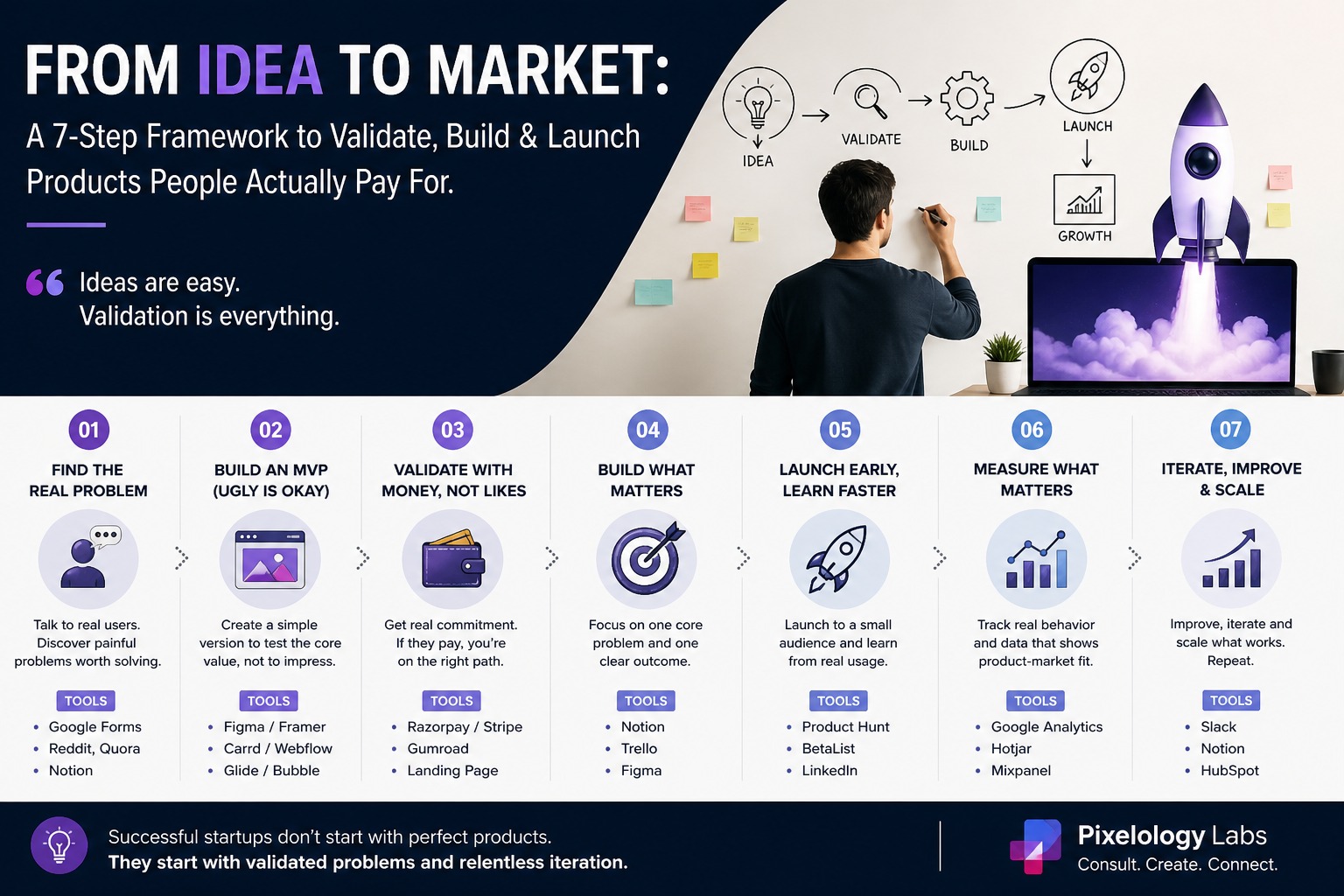
From Idea to Market: A 7-Step Framework to Validate & Launch Your Startup
Someone Already Had Your Idea. That Is Not the Problem.
The real problem? They did not execute it right. Or worse – they built something nobody wanted.
If you are sitting on a startup idea right now, this article is not here to motivate you. It is here to move you.
According to CB Insights, 35% of startups fail because there is no market need – not because the product was bad, but because nobody validated demand before building. That number has not changed in a decade, because the mistake keeps repeating.
Before you read further, stop and honestly answer these three questions:
- Would someone pay for your idea today – not someday, today?
- Can you explain your product in one clear sentence?
- Do you know exactly who will say “I need this right now”?
If you hesitated on any of them, you do not have a product yet. You have a thought.
Let us fix that.
Why Most Startup Ideas Fail to Reach the Market
The gap between idea and income is not funding. It is not competition. It is not even technology.
It is this: people build in isolation. Markets reward interaction.
The founders who succeed are not the ones with the best ideas. They are the ones who got out of their heads the fastest, talked to real users the soonest, and adjusted the quickest.
Here is the 7-step framework that separates the startups that make it from the ones that quietly disappear.
Step 1: Kill the Fantasy, Find the Real Problem
Most people start with: “I have an idea.”
Smart founders start with: “This problem is painful enough that people want it solved.”
There is a critical difference. Ideas are about you. Problems are about your customer.
How to find the real problem:
- Identify 10 real potential users – not friends, not family, not people who will be nice to you
- Ask them one question: “What frustrates you most about [this area of your life or business]?”
- Do not pitch. Do not explain your idea. Just listen.
- Look for the words that repeat across conversations – those words are your product roadmap
The psychology behind this: People do not buy products. They buy relief from a problem that is costing them time, money, or peace of mind. Your job is to find the pain, not create a solution looking for one.
Validation signal: When someone says “I would pay someone to fix that” – unprompted – you have found a real problem.
Step 2: Build Something Ugly, But Real (The MVP Mindset)
Perfection delays profit.
Your first version does not need to be beautiful. It does not need to be fully automated. It does not need to impress investors. It needs to answer one question: will someone take action?
What a real MVP looks like:
- A landing page that explains the product and has a sign-up button
- A WhatsApp demo where you manually deliver the service
- A basic clickable prototype built on Figma or Framer – free tools
- A manual service pretending to be a product (do the work by hand first, automate later)
The test: Put your MVP in front of 5 strangers. If none of them sign up, book a call, pay, or ask for more information – your idea needs work, not your pitch skills.
Reid Hoffman, co-founder of LinkedIn, said it best: “If you are not embarrassed by the first version of your product, you launched too late.”
The goal of an MVP is not to impress. It is to learn – as cheaply and quickly as possible.
Step 3: Validate With Money, Not Likes
Likes are lies.
When you post your idea on LinkedIn or Instagram and 200 people click the heart button, it means nothing. Those same 200 people will not open their wallets.
Real validation only happens when someone commits resources:
- A pre-order – they pay before the product is built
- A paid trial – they hand over money to test it
- A waiting list with urgency – they give up their email and time with clear intent to buy
A simple validation experiment you can run this week:
Create a post or a simple page that says: “Launching in 7 days – early access for ₹99.”
Track who actually pays. Even 5 paid sign-ups tells you more than 500 likes. Zero paid sign-ups tells you something critical before you waste months building.
The psychology behind this: Commitment reveals belief. When someone pays even a small amount they have declared that your solution is worth more to them than the money in their pocket. That is the only feedback that matters at this stage.
Step 4: Build What Matters (Not Everything)
Here is why most products fail even after validation: they try to do too much.
The startup graveyard is full of “all-in-one platforms” that solved every problem for no one in particular.
Successful products are ruthlessly focused:
- One core problem – not five related problems
- One clear outcome – what does the user’s life look like after using your product?
- One user type – not “small businesses, solopreneurs, enterprises, and freelancers”
The clarity test:
❌ “An all-in-one business management app”
✅ “An invoice tool for freelancers who hate accounting”
The second version converts because it speaks to one specific person in one specific painful moment. Clarity converts. Ambiguity kills.
When you sit down to build your product, ask yourself: if we could only ship one feature, what would it be? Build that. Ship it. Then add the second feature only after users ask for it.
Step 5: Your First 10 Customers Are Not Scalable (And That Is the Point)
The first instinct of most founders when they have a product ready: run ads.
Wrong.
You do not need ads first. You need conversations.
How to get your first 10 customers without spending a rupee on advertising:
- DM 50 people who match your ideal customer profile – on LinkedIn, WhatsApp, or Instagram
- Call leads directly – yes, pick up the phone
- Demo the product manually and in real time – share your screen, walk them through it
- Close each one yourself, personally, with follow-up
This feels unscalable. That is exactly why it works.
When you sell your first 10 customers by hand, you learn things no amount of ad data will tell you:
- The exact words they use to describe their problem (use these in your marketing copy)
- The objections that stop them from buying (address these on your sales page)
- The features they actually care about vs. the ones you thought they would care about
- The reason they chose you over doing nothing
You will learn more from 10 real conversations than from 10,000 ad impressions. This is not optional. It is the most important work you will do as a founder.
Step 6: Fix, Break, Repeat – Iteration Is the Strategy
Your first version will fail in small ways. Not everything will work—users may get confused, leave midway, or not connect with your message.
This is not failure. This is data.
The founders who win are not the ones who get it right on the first try. They are the ones who build systems to learn quickly and improve faster.
What to watch in your first 30 days after launch:
- Where users drop off – at which step do people stop and leave? That step is broken.
- What users complain about – complaints are free product roadmaps. Listen carefully.
- What users completely ignore – the features nobody uses are the features that should not exist.
How to gather this data without expensive tools:
- Google Analytics 4 (free) – shows you which pages people exit from
- Hotjar (free tier) – shows heatmaps of where users click and scroll
- A simple feedback form at the end of every session: “What almost stopped you from signing up today?”
- Direct messages to users after their first week: “What’s one thing we could improve?”
Then, improve only what the data says matters. Do not add features because you think they are cool. Add features because users are blocked without them.
Step 7: Now Scale – But Only After These 3 Things Are True
Scaling before product-market fit is the most expensive mistake a startup can make. You are not amplifying success – you are accelerating failure.
Only begin scaling when all three of these are true:
- People are paying – not just using for free, actually paying
- Users are coming back – retention is the truest signal of product value
- Referrals are starting – when users tell other people without being asked, you have something real
Once these three signals are present, then you scale:
- Run paid ads on Google and Meta targeting your validated audience
- Optimize your conversion funnel with A/B tested landing pages
- Automate the manual processes you have been doing by hand
- Build systems that let you deliver at 10x volume without 10x effort
Why this order matters: Scaling a broken product does not grow a business. It grows your losses – faster.
The Real Reason Products Do Not Reach Market
Let us be direct about this.
- It is not funding. Every bootstrapped product that validated demand found a way to get early capital.
- It is not competition. Every competitive market has room for a product that genuinely solves the problem better.
- It is not technology. Technology has never been more accessible or affordable than it is right now.
- The real reason is this: founders build in isolation and ask for feedback too late.
- They spend six months perfecting a product, then show it to the market for the first time – and discover the market does not want what they built. All of that time and money could have been redirected in week two if they had just talked to ten people first.
Markets reward interaction. The faster you put your idea in front of real people with real problems, the faster you find out whether you have a business or a hobby.
Your Quick Reality Check (Answer These Before Your Next Meeting)
If you have read this far, you are serious. So stop and answer these three questions right now:
- Who is your first customer? – Not a demographic. A real, specific person or company type you could name.
- What exact problem are you solving? – In one sentence, without jargon.
- How will you test it in the next 7 days? – Not plan. Test. What will you actually do this week?
If you do not have answers, do not read more articles. Start talking to people.
If you do have answers, you are ready for the next step.
The Gap Where Most Startups Die
Most founders get stuck between three painful transitions:
- Idea → Execution: The gap of confusion. You have a concept but no clear first action.
- Execution → Growth: The gap of chaos. You have early users but no repeatable system.
- Growth → Scale: The gap of plateaus. You have traction but cannot break through to the next level.
These three gaps are where products die – not because the idea was bad, but because the founder did not have the frameworks, the team, or the structured support to move through them.
How Pixelology Labs Helps You Close the Gap
At Pixelology Labs, we work with founders and business leaders who are serious about taking their ideas to market the right way.
We do not believe in building in isolation. We believe in structured validation, smart development, and growth systems that compound over time.
Our work covers the full journey:
- Digital strategy consulting – defining your market, your positioning, and your go-to-market approach before a single line of code is written
- MVP development – building the smallest, smartest version of your product that can generate real user and revenue data
- Product validation frameworks – helping you run real-world tests that give you data, not opinions
- Growth and scaling systems – automating, optimizing, and scaling once your product has proven its value
If you are sitting between idea and execution right now – or between execution and growth – that is exactly the gap we solve.
Book a free 30-minute strategy consultation with our team →
No pitch decks required. Just bring your idea and your honest answers to the three questions above.
Frequently Asked Questions
How long does it take to validate a startup idea?
A basic validation experiment can be run in 7 to 14 days. The goal is to find out whether real people will pay for your solution before you invest months in building it. Speed of validation is a competitive advantage.
What is the cheapest way to validate a startup idea?
The cheapest validation method is a direct conversation. Talk to 10 real potential customers before spending anything on development. Use free tools like a Google Form, a WhatsApp group, or a simple Carrd landing page to capture early interest.
What is an MVP and how is it different from a full product?
An MVP (Minimum Viable Product) is the simplest version of your product that can deliver value to a user and generate feedback. It is not a prototype and it is not a beta – it is a real, working solution with only the core features needed to solve the primary problem.
When should I start running paid ads for my startup?
Only after you have paying customers, measurable retention, and early referrals. Running ads before product-market fit accelerates burn, not growth.
How do I know if my startup idea is original enough?
Originality is less important than execution and positioning. Most successful startups entered existing markets and solved the same problem better, cheaper, or for a more specific audience. Focus on your differentiation, not on whether the idea has been done before.
Pixelology Labs is a digital transformation consulting firm based in Kochi, Kerala. We help founders, startups, and growing businesses build products people actually want – through structured strategy, smart development, and growth systems that scale.
Get in touch →